
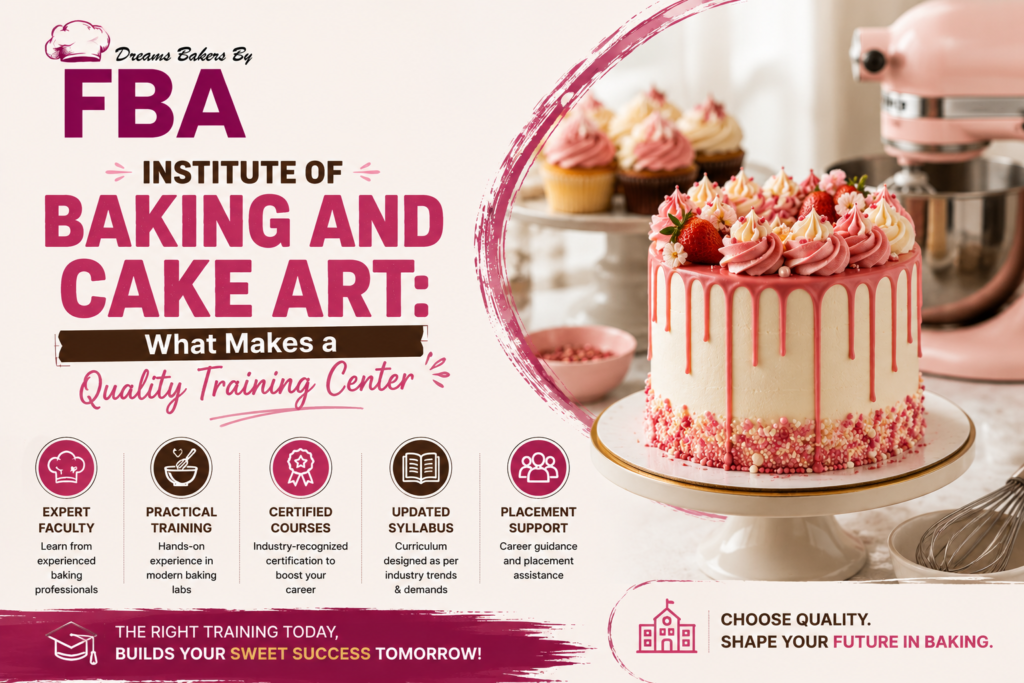
A professional baking institute should offer more than recipes and demonstrations. Students need practical exposure, suitable infrastructure, qualified instructors, structured training and enough access to equipment. These factors can directly influence how confidently a learner develops baking and cake-decorating skills.
For students considering a career in baking, pastry production or cake art, evaluating a training center before enrollment can help them make a more informed decision. Dreams Bakers by FBA focuses on practical baking education designed to help learners develop industry-relevant skills in a structured training environment.
What Is an Institute of Baking and Cake Art?
An institute of baking and cake art is a training center that provides education in baking, pastry preparation, cake making, decoration and related culinary techniques.
Unlike casual baking workshops, a professional institute generally follows a structured curriculum. Students can progress from fundamental techniques to more advanced preparation and presentation skills.
Key Areas Usually Covered
A quality training program may include:
- Baking fundamentals
- Ingredient knowledge
- Cake preparation
- Bread and pastry basics
- Frosting techniques
- Cake decoration
- Piping and finishing
- Food hygiene
- Equipment handling
- Presentation techniques
- Practical assessments
The exact curriculum varies between institutes, so prospective students should always review the syllabus before enrolling.
Why Choosing the Right Baking Institute Matters
Learning baking involves both theoretical understanding and practical repetition. Watching demonstrations alone may not provide enough experience to handle professional equipment or troubleshoot common baking problems.
A good baking institute should create opportunities for students to practise techniques under guidance.
| Training Factor | Why It Matters |
| Practical sessions | Helps students develop hands-on skills |
| Modern equipment | Builds familiarity with professional tools |
| Qualified instructors | Provides technical guidance |
| Structured syllabus | Creates progressive learning |
| Small or manageable batches | Allows better individual attention |
| Assessments | Helps identify areas for improvement |
| Hygiene training | Develops professional working habits |

Infrastructure: A Major Sign of Training Quality
Infrastructure is one of the first things students should evaluate when visiting a baking academy.
A professional learning environment should have appropriate workstations, ovens, mixers, refrigeration facilities, preparation areas and other equipment required for practical training.
What to Check in Baking Infrastructure
Students should look for:
- Functional baking ovens
- Mixing equipment
- Preparation workstations
- Refrigeration facilities
- Cake decorating tools
- Measuring equipment
- Storage facilities
- Cleaning and sanitation arrangements
- Adequate workspace
Infrastructure should not simply look modern. More importantly, students should have meaningful access to it during practical sessions.
Student-to-Equipment Ratio
One of the most overlooked factors when choosing a baking academy is the student-to-equipment ratio.
If too many students have to share a limited number of machines or workstations, individual practical exposure may be reduced. Students may spend more time watching others instead of performing tasks themselves.
A balanced student-to-equipment ratio can provide more opportunities for hands-on learning.
| Classroom Situation | Potential Learning Experience |
| Few students, adequate equipment | High practical exposure |
| Moderate batch, sufficient workstations | Balanced learning |
| Large batch, limited equipment | Less individual practice |
| Large batch, adequate equipment | Better than limited-equipment batches |
When visiting an institute, ask how practical sessions are conducted and whether every learner gets an opportunity to operate the equipment.
Instructor Qualifications and Industry Experience
The quality of instruction can significantly influence the learning experience.
An experienced instructor should understand not only how to prepare a product but also why particular techniques work. They should be able to explain mistakes, provide corrections and demonstrate professional methods.
What Makes a Good Baking Instructor?
Look for instructors who demonstrate:
- Relevant professional education
- Practical baking experience
- Knowledge of modern baking techniques
- Strong communication skills
- Patience with beginners
- Ability to demonstrate techniques clearly
- Understanding of food safety and hygiene
- Experience with cake decoration and presentation
Instructor qualifications should be considered alongside practical industry experience rather than evaluated solely on certificates.
Curriculum: Look Beyond the Course Name
Two institutions may offer courses with similar names but completely different syllabi.
For example, one baking academy may focus primarily on basic cakes, while another may cover cake decoration, pastry, bread, food safety and production techniques.
What Should a Baking Curriculum Include?
A well-structured curriculum can move through different learning stages.
| Stage | Learning Focus |
| Foundation | Ingredients, measurements and basic methods |
| Baking | Batter preparation and baking techniques |
| Cake finishing | Frosting and layering |
| Cake art | Piping, decoration and presentation |
| Professional skills | Hygiene, consistency and workflow |
| Assessment | Practical evaluation and improvement |
Students should compare the actual modules rather than selecting a program simply because its title sounds professional.
Practical Training vs Demonstration-Based Learning
Baking is a hands-on skill. Demonstrations are useful for understanding techniques, but students also need opportunities to perform those techniques independently.
A strong training center should balance demonstration and practice.
Why Practical Exposure Matters
Practical training helps students learn how to:
- Measure ingredients accurately
- Operate baking equipment
- Prepare mixtures correctly
- Identify texture problems
- Control baking conditions
- Apply frosting
- Practise piping
- Finish cakes neatly
- Maintain a clean workstation
Repeated practice can help learners become more comfortable with the complete baking process.

Hygiene and Food Safety Training
Professional baking education should also address hygiene.
Students should understand proper handling of ingredients, clean workstations, equipment sanitation, personal hygiene and safe storage practices.
| Hygiene Area | Training Importance |
| Personal hygiene | Supports safe food preparation |
| Workstation cleaning | Maintains a professional environment |
| Equipment sanitation | Reduces contamination risks |
| Ingredient storage | Protects product quality |
| Temperature control | Supports safe handling |
| Waste management | Encourages responsible workflow |
These practices are particularly valuable for learners who eventually want to work in commercial kitchens or operate a home-based baking business.
Assessments and Feedback
A quality baking institute should provide some form of evaluation during the learning process.
Assessments can help students understand whether they have successfully developed a particular technique.
Useful Assessment Methods
These may include:
- Practical assignments
- Product preparation
- Cake decoration tasks
- Technique demonstrations
- Final practical assessments
- Instructor feedback
Feedback is particularly important because beginners may not immediately recognize why a product did not turn out as expected.
Equipment and Technology
Modern baking involves a wide range of equipment. Students should ideally become familiar with the tools they are likely to encounter in professional or commercial environments.
A training center should explain the correct use of equipment rather than simply allowing students to observe instructors.
Equipment Exposure Can Include
Depending on the program, learners may encounter:
- Baking ovens
- Planetary or stand mixers
- Refrigeration equipment
- Weighing scales
- Cake turntables
- Piping tools
- Decorating equipment
- Baking moulds
- Temperature-measuring tools
The objective should be to build safe and confident equipment-handling habits.
How to Compare a Baking Academy Before Enrollment
Students should avoid choosing an institute based only on advertisements or course fees.
Instead, compare multiple factors before making a decision.
| Evaluation Factor | Questions to Ask |
| Infrastructure | What equipment is available? |
| Practical training | How much hands-on practice is included? |
| Instructors | What are their qualifications and experience? |
| Batch size | How many students are in each batch? |
| Equipment access | How many students share each workstation? |
| Curriculum | What topics are covered? |
| Duration | Is the course length suitable for the syllabus? |
| Certification | Is a certificate provided on completion? |
| Assessments | How is student performance evaluated? |
| Schedule | Are weekday or weekend options available? |
The Baking and Pastry Institute vs Short Workshops
A full the baking and pastry institute style program generally provides broader exposure than a single-topic workshop. However, the right option depends on the student’s objective.
Someone who wants to explore baking may prefer a focused course, while someone planning a professional culinary career may need broader training.
Choose Based on Your Goal
| Goal | Suitable Training Approach |
| Hobby baking | Short practical course |
| Cake decoration | Specialized cake art course |
| Home baking | Baking and decoration fundamentals |
| Professional career | Comprehensive baking program |
| Skill enhancement | Advanced focused workshop |
| Career exploration | Foundation-level program |
Why Dreams Bakers by FBA Can Be Considered
Dreams Bakers by FBA provides a structured environment for learners interested in baking and cake art. When evaluating any baking academy, students should consider practical training, instructor expertise, infrastructure and equipment accessibility alongside the curriculum.
For beginners, these factors can make the difference between simply learning recipes and developing transferable baking skills.
A quality institute of baking and cake art should ultimately focus on building practical competence. The best training environment is not necessarily the one with the most impressive advertising or the longest course title. It is the one that gives students meaningful practice, knowledgeable guidance, suitable infrastructure and a clear learning pathway.
Frequently Asked Questions
1. What should I look for in an institute of baking and cake art?
Look at the curriculum, practical training, infrastructure, instructor qualifications, equipment availability, batch size, student-to-equipment ratio and assessment methods before enrolling.
2. Why is infrastructure important in a baking institute?
Good infrastructure provides students with access to suitable ovens, mixers, workstations and decorating equipment, helping them gain practical experience.
3. What is the student-to-equipment ratio?
The student-to-equipment ratio refers to how many learners share available equipment or workstations. A manageable ratio can provide more opportunities for individual practice.
4. Are instructor qualifications important when choosing a baking academy?
Yes. Relevant qualifications combined with practical industry experience can help instructors explain techniques, correct mistakes and provide useful professional guidance.
5. Is practical training important for baking students?
Yes. Baking requires hands-on practice. Students need opportunities to prepare products, operate equipment and practise decoration techniques rather than relying only on demonstrations.
6. What should a professional baking curriculum include?
Depending on the program, it may include baking fundamentals, ingredient knowledge, cake preparation, pastry, frosting, decoration, equipment handling, hygiene and practical assessments.
7. How can I compare different baking institutes?
Compare their syllabus, infrastructure, practical hours, instructors, equipment, batch sizes, course duration, assessments and certification instead of comparing fees alone.
8. Is a baking academy suitable for beginners?
Yes. Beginner-friendly programs can introduce students to baking fundamentals before progressing to more advanced cake and pastry techniques.
9. Should I choose a short workshop or a full baking course?
It depends on your objective. A workshop may suit focused skill development, while a comprehensive course can be more suitable for learners seeking broader baking knowledge.
10. Does Dreams Bakers by FBA provide baking and cake art training?
Dreams Bakers by FBA offers baking-focused training for learners interested in developing practical skills in cake baking and related areas. Students should review the current course structure and batch details before enrollment.