
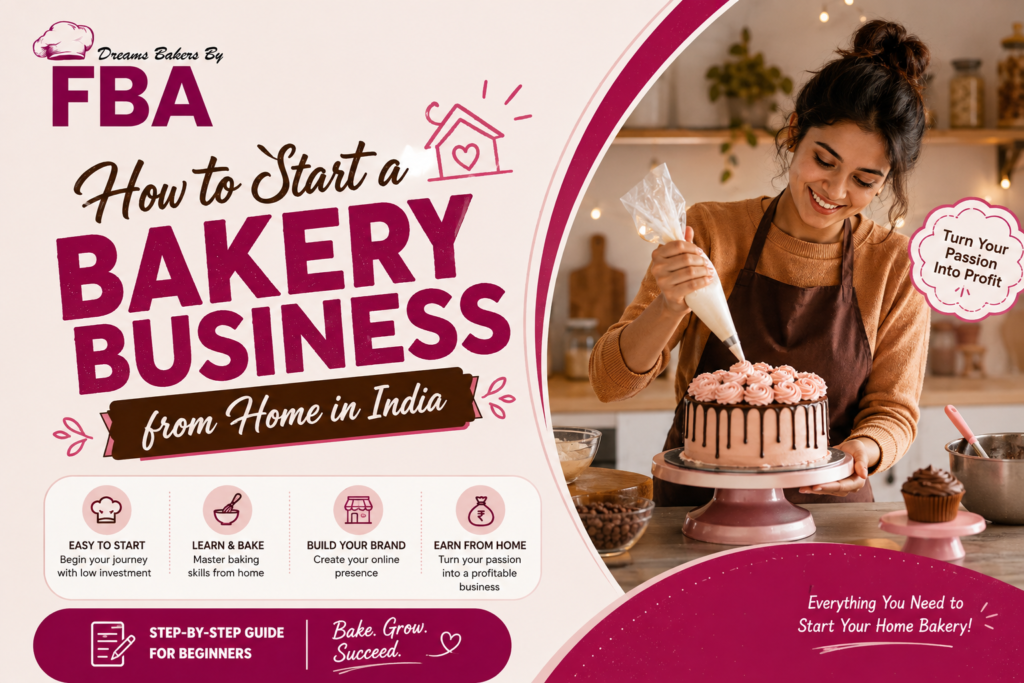
Starting a bakery from home can be an attractive option for aspiring entrepreneurs who enjoy baking and want to build a business without immediately investing in a commercial storefront. From customised cakes and cupcakes to cookies, brownies and other baked products, a home-based bakery can begin on a small scale and grow with customer demand.
However, knowing how to start a bakery business involves more than learning recipes. A successful home bakery requires planning, food safety compliance, accurate pricing, reliable delivery, consistent product quality and effective marketing.
For a new home baker, starting small can make it easier to understand customer preferences, manage costs and improve operations before expanding. Dreams Bakers by FBA can also help aspiring bakers develop practical baking skills before entering the business side of the industry.
Is a Home Bakery a Good Business Opportunity?
A home bakery can be started with a focused product range and a manageable order volume. Instead of offering dozens of products immediately, beginners can specialise in a few categories.
Popular options may include:
- Celebration cakes
- Cupcakes
- Brownies
- Cookies
- Tea cakes
- Dessert boxes
- Pastries
- Customised cakes
The right product mix depends on your skills, target customers, equipment and local demand.
| Business Model | Suitable For | Main Advantage |
| Custom cakes | Skilled decorators | Higher-value orders |
| Cupcakes | Beginners | Easier batch production |
| Brownies | Small businesses | Simple packaging |
| Cookies | Repeat customers | Longer shelf life for some varieties |
| Dessert boxes | Social media businesses | Attractive gifting option |
| Mixed bakery | Experienced bakers | Wider customer base |
Step 1: Decide What Your Bakery Will Sell
The first step in starting a bakery is deciding what products you will offer.
A common mistake is trying to sell everything from the beginning. A smaller menu can make purchasing, production, costing and quality control easier.
Choose a Specific Product Category
Consider your strongest baking skills and the type of customers you want to serve.
For example, a beginner may start with cupcakes and brownies, while an experienced cake decorator may focus on customised celebration cakes.
Before finalising your menu, consider:
- Ingredient availability
- Preparation time
- Equipment requirements
- Packaging requirements
- Expected demand
- Product shelf life
- Delivery suitability
- Profit margins
Step 2: Understand FSSAI Requirements
Food businesses in India need to pay attention to applicable food safety and licensing requirements. The FSSAI license or registration applicable to a business depends on factors such as its nature and scale.
Before starting commercial operations, check the latest requirements directly through the Food Safety and Standards Authority of India’s official portal and determine which registration or licence applies to your business.
Home Kitchen Compliance
Operating from home does not automatically mean food safety requirements can be ignored. A home baker should maintain appropriate hygiene, ingredient storage, cleanliness and food-handling practices.
| Area | What to Consider |
| Food registration | Determine applicable FSSAI requirement |
| Kitchen hygiene | Maintain a clean preparation area |
| Ingredient storage | Store ingredients appropriately |
| Food handling | Follow safe preparation practices |
| Packaging | Use suitable food-contact packaging |
| Labelling | Follow applicable requirements |
| Records | Maintain relevant business and food records |
Requirements can change, so verify current regulations before launching or expanding.
Step 3: Set Up Your Home Kitchen
You do not necessarily need a large commercial kitchen to begin a small bakery operation. However, your workspace should support safe and organised production.
Essential equipment can vary depending on your menu.
Basic Equipment Checklist
| Equipment | Purpose |
| Oven | Baking cakes and other products |
| Mixer | Preparing batter and frosting |
| Digital weighing scale | Accurate measurements |
| Baking moulds | Different product shapes |
| Cooling racks | Cooling baked products |
| Spatulas | Mixing and finishing |
| Piping bags and tips | Cake decoration |
| Refrigerator | Ingredient and product storage |
| Measuring tools | Consistent preparation |
Invest in equipment according to your actual production requirements rather than purchasing everything at once.
Step 4: Calculate Your Bakery Pricing
Pricing is one of the most important parts of a baking business.
Many new home bakers calculate only the cost of flour, sugar, chocolate and other ingredients. This can result in prices that are too low to sustain the business.
Your pricing should consider multiple expenses.
What Should Be Included in Product Cost?
| Cost Component | Example Consideration |
| Ingredients | Flour, sugar, chocolate, dairy, etc. |
| Packaging | Boxes, boards, labels and inserts |
| Electricity/gas | Oven and equipment usage |
| Labour | Your preparation and decoration time |
| Delivery | Delivery charges where applicable |
| Wastage | Damaged or unused ingredients |
| Marketing | Advertising and promotional expenses |
| Overheads | Cleaning, equipment maintenance, etc. |
A simple pricing formula can begin with:
Total Cost = Ingredients + Packaging + Labour + Utilities + Other Allocated Costs
You can then add an appropriate profit margin based on your product, market and business strategy.
Step 5: Build a Practical Product Menu
Your menu should be easy for customers to understand and manageable for you to produce.
Avoid creating a menu with too many customisation options initially. Too many combinations can make inventory management and production planning difficult.
A Beginner-Friendly Menu Structure
You could organise your menu into:
Standard Products
- Classic cakes
- Brownies
- Cookies
- Cupcakes
Premium Products
- Customised cakes
- Designer cakes
- Gift boxes
Add-ons
- Cake toppers
- Greeting cards
- Candles
- Additional decoration
This structure can make ordering simpler while allowing customers to choose upgrades.
Step 6: Create a Reliable Ordering System
A professional ordering process can reduce confusion between the customer and the baker.
Decide in advance:
- How customers place orders
- How much advance notice is required
- What payment method you accept
- Whether an advance payment is required
- How cancellations are handled
- How customisation requests are confirmed
- When orders are collected or delivered
For customised cakes, written confirmation of the design, flavour, size, date and price can help prevent misunderstandings.
Step 7: Plan Delivery Logistics Carefully
Delivery logistics can become challenging when cakes and other delicate products are involved.
A home baker should determine the delivery area before accepting orders. Large delivery distances may increase costs and create greater risks for delicate products.
Delivery Factors to Consider
| Factor | Why It Matters |
| Distance | Influences delivery cost |
| Product type | Cakes may require careful handling |
| Weather | Heat can affect certain products |
| Packaging | Protects the product during transport |
| Delivery timing | Helps maintain freshness and presentation |
| Delivery partner | Reliability affects customer experience |
For highly customised cakes, careful handling and suitable transportation arrangements are particularly important.
Step 8: Create Your Bakery Brand
A baking business needs a clear identity. Your brand name, packaging, photography and social media presence should communicate what makes your bakery different.
For example, you could position your home bakery around:
- Custom celebration cakes
- Eggless cakes
- Premium desserts
- Budget-friendly cakes
- Corporate gifting
- Themed birthday cakes
- Special occasion desserts
A focused positioning can help customers quickly understand what you offer.
Step 9: Use Digital Marketing to Find Customers
Social media can be useful for showcasing bakery products. High-quality photographs and short videos can demonstrate decoration, preparation and finished products.
Content Ideas for a Home Baker
| Content Type | Purpose |
| Product photographs | Showcase finished cakes |
| Decorating videos | Demonstrate skills |
| Behind-the-scenes content | Show preparation |
| Menu posts | Communicate products and pricing |
| Seasonal offers | Encourage timely orders |
| Customer FAQs | Answer common questions |
Google Business Profile may also be relevant for eligible local businesses, while social media can help build awareness within the target service area.
Step 10: Track Every Order and Expense
A small bakery can quickly become difficult to manage if financial records are not maintained.
Track:
- Orders
- Revenue
- Ingredient expenses
- Packaging costs
- Delivery expenses
- Equipment purchases
- Wastage
- Profit
- Customer preferences
Simple spreadsheets can be sufficient when the business is small.
Example Monthly Business Tracking
| Metric | Why Track It? |
| Total orders | Measures demand |
| Average order value | Helps understand customer spending |
| Ingredient cost | Controls margins |
| Delivery cost | Measures logistics expense |
| Repeat customers | Indicates customer retention |
| Net profit | Measures business performance |
Should You Learn Baking Before Starting a Bakery?
Yes. Product quality is one of the foundations of a successful bakery.
If you cannot consistently produce the products you sell, marketing and pricing alone will not solve the problem. Practical baking education can help beginners understand ingredients, techniques, equipment and decoration.
A structured baking course can also reduce the learning curve for someone who wants to move from hobby baking toward commercial production.
Why Practical Baking Training Helps
| Skill | Business Benefit |
| Consistent baking | Better product quality |
| Cake decoration | Supports premium products |
| Ingredient knowledge | Better costing and troubleshooting |
| Equipment handling | More efficient production |
| Food hygiene | Safer preparation practices |
| Time management | Improved order fulfilment |
How Dreams Bakers by FBA Can Help Aspiring Home Bakers
Dreams Bakers by FBA provides baking-focused training for learners who want to develop practical baking and cake-making skills.
For someone planning a home bakery, learning the technical side of baking before taking commercial orders can be valuable. Once the baking foundation is strong, entrepreneurs can focus on pricing, branding, order management, delivery and customer acquisition.
The goal should not be to build a large bakery immediately. Start with manageable production, understand your market, maintain consistent quality and gradually expand as demand becomes predictable.
Common Mistakes New Home Bakers Should Avoid
Many new entrepreneurs make avoidable mistakes when launching their first baking business.
| Mistake | Better Approach |
| Underpricing products | Calculate complete costs |
| Offering too many products | Start with a focused menu |
| Ignoring delivery costs | Include logistics in pricing |
| Accepting unrealistic deadlines | Set clear order timelines |
| Buying excessive equipment | Invest according to demand |
| Ignoring food regulations | Check current applicable requirements |
| Inconsistent product quality | Standardise recipes and processes |
| Poor order records | Maintain organised records |
Final Thoughts
Learning how to start a bakery business from home requires both baking knowledge and business planning. A home baker needs to think beyond recipes and consider compliance, kitchen organisation, equipment, pricing, packaging, delivery logistics and marketing.
Starting small can be a practical strategy. Focus on a limited product range, build consistency, understand your costs and create a reliable ordering system. With the right skills and gradual business development, a home kitchen can become the foundation for a sustainable baking business.
Frequently Asked Questions
1. How can I start a bakery business from home in India?
Begin by developing your baking skills, choosing a focused product range, checking applicable FSSAI requirements, preparing your kitchen, calculating prices and creating a reliable ordering and delivery system.
2. Does a home baker need an FSSAI license or registration?
Food business operators may need applicable FSSAI registration or licensing depending on their circumstances. Check the latest requirements through FSSAI before starting commercial food operations.
3. How much does it cost to start a home bakery?
The investment varies depending on your existing kitchen equipment, product range, packaging requirements and production capacity. Starting with a focused menu can help control initial costs.
4. How should I price homemade cakes?
Consider ingredients, packaging, labour, utilities, wastage, delivery and other business expenses before adding an appropriate profit margin.
5. What products are suitable for a beginner baking business?
Cakes, cupcakes, brownies, cookies and dessert boxes can be considered, depending on your skills, equipment, local demand and delivery requirements.
6. Is baking training necessary before starting a home bakery?
Formal training is not the only way to learn baking, but structured practical training can help beginners develop consistency, technical skills, equipment knowledge and decoration abilities.
7. How can I manage cake delivery from home?
Define your delivery radius, use suitable packaging, schedule realistic delivery times and consider the handling requirements of each product.
8. Can a home bakery become a full-time business?
Yes, some home-based businesses can grow over time. Expansion depends on product demand, operational capacity, compliance, profitability and the entrepreneur’s ability to manage increasing orders.
9. How many products should I offer when starting a baking business?
A focused menu is usually easier to manage initially. You can expand the range after understanding customer demand and production capacity.
10. Can Dreams Bakers by FBA help me prepare for a home baking business?
Dreams Bakers by FBA provides practical baking-focused training that can help learners build foundational baking and cake-making skills before exploring entrepreneurship.