
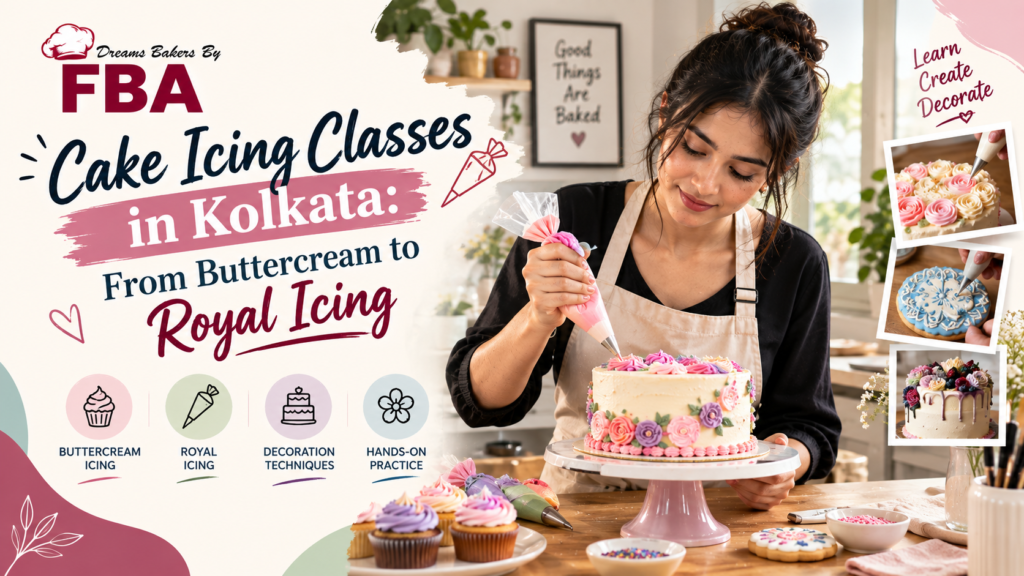
Cake icing is one of the most important skills for anyone who wants to create attractive, professional-looking cakes. From a simple smooth finish to detailed piping and textured designs, the right icing technique can completely change the appearance of a cake.
For beginners and aspiring cake artists, cake icing classes provide structured practice in essential techniques such as buttercream application, color mixing, piping, and royal icing decoration.
What Do You Learn in Cake Icing Classes?
A good cake icing course usually combines basic techniques with hands-on practice. Students learn how different icings behave and how to use the right tools for different cake designs.
| Skill | What You Learn |
| Buttercream icing | Preparing, coloring, spreading, and piping |
| Royal icing | Consistency control and detailed decoration |
| Smooth finish | Creating clean and even cake surfaces |
| Piping | Borders, flowers, rosettes, and patterns |
| Color mixing | Creating shades and coordinating colors |
| Textured designs | Adding patterns and decorative effects |
| Practice boards | Developing piping control before decorating cakes |
Buttercream Icing
Buttercream is widely used because it is versatile and suitable for both simple and detailed designs. Students can practice spreading, smoothing, piping, and creating decorative patterns.
Royal Icing
Royal icing is commonly used for detailed decorations, cookies, fine piping, and decorative elements. Learning its consistency is important because the icing needs to be adjusted according to the technique being used.

Why Hands-On Practice Matters
Icing skills improve mainly through repeated practice. Watching a demonstration can explain the process, but practical training helps students understand pressure control, consistency, movement, and finishing.
Practice boards are particularly useful for beginners. They allow students to repeat piping patterns without using a complete cake for every practice session.
| Practice Area | Skill Developed |
| Lines and curves | Hand control |
| Shell borders | Consistent pressure |
| Rosettes | Circular movement |
| Leaves | Piping angle |
| Textures | Nozzle control |
| Writing | Fine motor control |
Cake Decoration Techniques You Can Master
Cake icing is more than simply covering a cake with cream. Different techniques can create completely different visual effects.
Smooth Finish
A smooth finish creates a clean, polished appearance. It requires controlled application of icing followed by careful smoothing with appropriate tools.
Textured Designs
Textured designs add depth and character to cakes. Different piping tips and techniques can create ruffles, waves, ridges, swirls, and other patterns.
Color Mixing
Color mixing is another important part of cake decoration. Students learn how to create complementary shades and adjust intensity according to the desired design.
Piping Decorations
Piping can be used for borders, flowers, lettering, rosettes, shells, and other decorative elements. Consistent pressure and correct nozzle positioning are essential for clean results.

Cake Icing Classes vs Self-Learning
Many beginners start by watching online tutorials. While this can be useful, structured classes provide a more organized learning experience with practical guidance.
| Learning Method | Main Advantage | Common Challenge |
| Online tutorials | Convenient and accessible | Limited personal feedback |
| Practice at home | Flexible schedule | Technique can take longer to develop |
| Cake icing classes | Guided practical training | Requires scheduled attendance |
| Cake icing course | Structured skill development | Course quality varies by institute |
For learners who want to build a strong foundation, classroom practice can make it easier to identify and correct technique-related mistakes.
What Should You Look for in a Cake Icing Course?
Not every course provides the same level of practical training. Before enrolling, compare the curriculum, practice opportunities, equipment, and instructor guidance.
| Factor | What to Check |
| Practical sessions | Whether students decorate cakes themselves |
| Icing techniques | Buttercream, royal icing, piping, and smoothing |
| Equipment | Availability of relevant tools and nozzles |
| Practice boards | Whether repeated piping practice is included |
| Class size | Whether students can receive individual guidance |
| Course structure | Beginner to advanced progression |
| Certification | Whether a certificate is provided after completion |
Can You Learn Decoration of Cake at Home?
Yes, beginners can practice the decoration of cake at home after learning the basic techniques. However, home practice requires patience because consistency and piping control develop gradually.
A simple practice routine can include:
| Practice Stage | Recommended Focus |
| Stage 1 | Basic lines and pressure control |
| Stage 2 | Shells, stars, and borders |
| Stage 3 | Rosettes and simple flowers |
| Stage 4 | Smooth cake finishing |
| Stage 5 | Textured designs |
| Stage 6 | Complete cake decoration |
Starting with practice boards before moving to full cakes can help reduce wastage and build confidence.
Career and Business Opportunities After Learning Cake Icing
Icing skills can support several baking-related goals. Students can use these techniques for personal baking, freelance cake orders, home-based businesses, or further professional bakery training.
| Goal | How Icing Skills Help |
| Home baking | Create attractive celebration cakes |
| Custom cake orders | Offer personalized designs |
| Bakery career | Strengthen practical decoration skills |
| Freelancing | Take small cake decoration projects |
| Advanced training | Build a foundation for professional cake artistry |
Building a Strong Portfolio
A portfolio can demonstrate your progress and range of techniques. Photograph cakes with different finishes, colors, piping patterns, and decoration styles.
Consistent practice combined with good presentation can help beginners understand their strengths and identify techniques that need more improvement.
Final Thoughts
Learning cake icing is a practical skill that becomes stronger with proper instruction and regular practice. Cake icing classes can introduce beginners to buttercream, royal icing, smooth finishes, textured designs, color mixing, and professional piping techniques.
Whether your goal is to decorate cakes at home, improve your baking skills, or explore professional cake decoration, structured training can provide a useful foundation. With consistent practice and the right techniques, even beginners can gradually create cleaner and more creative cake designs.
Frequently Asked Questions
1. What are cake icing classes?
Cake icing classes are practical training sessions that teach techniques such as buttercream application, royal icing, piping, smoothing, color mixing, and cake decoration.
2. What is covered in a cake icing course?
A cake icing course may cover buttercream, royal icing, piping techniques, smooth finishing, textured designs, color mixing, and decorative cake elements.
3. Can beginners join cake icing classes?
Yes. Beginner-friendly classes generally start with basic icing preparation, spreading, piping, and finishing before moving to more detailed decoration techniques.
4. Is buttercream easier than royal icing?
Buttercream is often more versatile for cake covering and piping, while royal icing is commonly used for detailed decorative work. The difficulty depends on the specific technique.
5. Can I learn cake decoration at home?
Yes. Basic cake decoration can be practiced at home using suitable tools, icing, and practice boards. Regular practice is important for developing consistency.
6. Why are practice boards useful for icing?
Practice boards allow learners to repeat piping movements and improve pressure control before applying designs to an actual cake.
7. Do cake icing classes teach color mixing?
Many cake icing courses include color mixing so students can create different shades and coordinate colors for specific cake designs.
8. How long does it take to learn cake icing?
Basic techniques can be learned relatively quickly, but developing consistent piping, smooth finishing, and detailed decoration requires regular practice.
9. Can cake icing skills help with a home baking business?
Yes. Cake icing skills can help home bakers create customized cakes and expand the range of designs they can offer to customers.
10. What should I check before joining cake icing classes?
Check the practical curriculum, icing techniques covered, instructor guidance, equipment, practice sessions, class size, and whether students receive a certificate.