
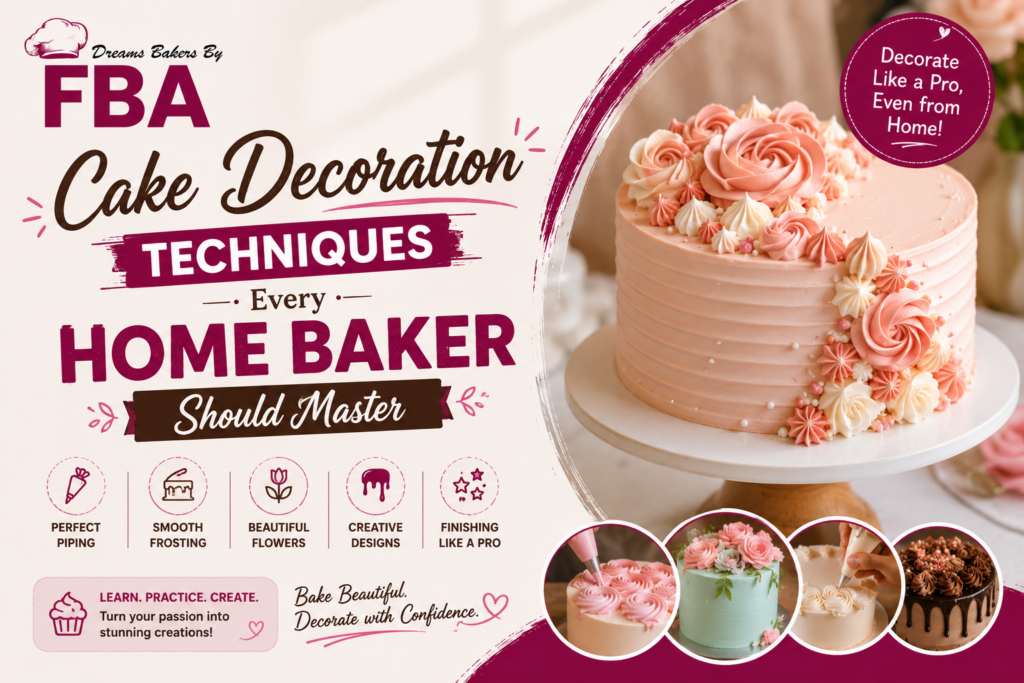
Baking a cake is only the beginning. The finishing, texture, colours and presentation can transform a simple homemade cake into something that looks professionally prepared. For home bakers, learning the right cake decoration techniques can make it easier to create attractive cakes for birthdays, celebrations, family occasions or even a small baking business.
Cake decoration does not always require advanced equipment or years of experience. With the right techniques and regular practice, beginners can learn essential skills such as buttercream piping, smooth icing, ganache drip, fondant basics and edible flower decoration.
For learners who want structured guidance, cake icing classes and cake design classes can provide hands-on practice with professional tools and techniques. Dreams Bakers by FBA offers baking-focused training for learners interested in developing practical cake-making and decoration skills.
Why Cake Decoration Matters for Home Bakers
A well-baked cake can taste delicious, but decoration adds another level of presentation. For home bakers, good decoration skills can also help create more consistent results.
Cake decoration involves several individual techniques, including preparing the right consistency of frosting, creating smooth surfaces, controlling piping pressure and placing decorative elements correctly.
| Cake Decoration Skill | What It Helps You Achieve |
| Smooth icing | Clean and professional-looking finish |
| Buttercream piping | Borders, flowers and patterns |
| Ganache drip | Modern decorative finish |
| Fondant basics | Clean shapes and themed designs |
| Edible flowers | Elegant presentation |
| Cake lettering | Personalised messages |
| Layering | Better structure and visual appeal |
Master Smooth Cake Icing First
Before learning complicated decorations, home bakers should understand how to create a smooth cake surface.
Smooth icing creates a clean base for additional decorations. Uneven frosting can make even carefully designed decorations look less polished.
Basic Icing Process
A simple approach is to:
- Allow the cake layers to cool completely.
- Level the layers if necessary.
- Apply a thin crumb coat.
- Chill the cake when appropriate.
- Apply the final layer of icing.
- Smooth the sides and top using suitable tools.
The consistency of the frosting is important. If it is too soft, it may not hold its shape. If it is too firm, spreading and smoothing can become difficult.
Buttercream Piping Techniques
Buttercream piping is one of the most useful skills for a home baker. Once you understand piping pressure and consistency, you can create borders, rosettes, shells, stars and other decorative patterns.
Start With Basic Piping Tips
Beginners do not need dozens of piping tips. A small selection can be enough to learn fundamental techniques.
| Piping Technique | Common Use |
| Star piping | Borders and rosettes |
| Round piping | Dots and lettering |
| Shell piping | Decorative borders |
| Leaf piping | Floral designs |
| Petal piping | Buttercream flowers |
The key is consistency. Try practising on parchment paper or a reusable practice surface before piping directly onto a finished cake.
Cake Border and Edge Decoration
Borders can make a cake look more finished. They can also hide minor imperfections around the edges.
Home bakers can practise simple borders using different piping tips and pressures. Once basic patterns become comfortable, they can combine multiple techniques to create more detailed designs.
Common Border Styles
Popular beginner-friendly options include:
- Shell borders
- Star borders
- Dot borders
- Rope-style patterns
- Beaded borders
- Small piped flowers
The objective should be to maintain consistent pressure and spacing throughout the design.
Ganache Drip Technique
A ganache drip is a popular cake decoration technique that creates a modern and attractive finish. It can be used on celebration cakes, chocolate cakes and contemporary dessert designs.
The main challenge is controlling the consistency of the ganache. It should be fluid enough to create a drip but stable enough to remain on the cake.
Tips for Better Ganache Drips
Before applying ganache:
- Ensure the cake surface is properly chilled if required.
- Test the ganache consistency.
- Apply a small test drip first.
- Adjust the consistency if necessary.
- Work around the cake carefully.
- Finish the top surface after creating the drip.
Practising on a smaller cake can help beginners understand how the ganache behaves.
Fondant Basics for Home Bakers
Fondant provides a smooth surface and can be used to create themed cake decorations. Learning fondant basics can be useful for birthday cakes, celebration cakes and character-inspired designs.
Fondant can be rolled, shaped and cut into decorative elements.
Beginner Fondant Skills
Start by learning how to:
- Roll fondant evenly
- Prevent sticking
- Cover simple cake surfaces
- Cut basic shapes
- Create small decorative pieces
- Smooth edges
- Store unused fondant properly
Beginners should focus on simple shapes before attempting highly detailed figures.
Edible Flowers for Elegant Cake Design
Edible flowers can create an elegant appearance without requiring complex piping skills. They can be incorporated into cakes for birthdays, anniversaries, celebrations and other occasions.
However, only flowers that are specifically safe for food use should be placed directly on cakes. Decorative flowers that are not intended for consumption should not be treated as edible simply because they look suitable.
| Decoration | Suitable Cake Style |
| Edible flowers | Elegant and minimal cakes |
| Buttercream flowers | Floral celebration cakes |
| Chocolate decorations | Contemporary cakes |
| Fondant shapes | Themed cakes |
| Fresh fruit | Fresh and colourful designs |
| Ganache drip | Modern dessert cakes |
Cake Lettering and Personalisation
Cake lettering allows home bakers to customise cakes with names, short messages or celebration details.
Beginners can start with simple piped lettering before progressing to fondant or chocolate lettering.
How to Improve Cake Lettering
Practise:
- Consistent letter size
- Even spacing
- Controlled piping pressure
- Simple fonts
- Straight baselines
- Short messages
It is usually easier to practise lettering on parchment or a flat surface before attempting it on a finished cake.
Colour Coordination in Cake Design
Good bakery decoration is not only about adding more elements. Colour selection and balance can make a significant difference.
Using too many colours or decorative elements can make a cake appear visually crowded. A simple colour palette can often create a cleaner result.
| Design Approach | Result |
| Two complementary colours | Clean and balanced |
| Monochromatic shades | Elegant appearance |
| Pastel palette | Soft decorative look |
| Bold contrasting colours | Strong visual impact |
| Neutral base with accents | Modern presentation |
Cake Design Classes: What Beginners Can Learn
For people who want to develop decoration skills systematically, cake design classes can provide structured practical learning.
Instead of learning one technique at a time from unrelated tutorials, students can follow a progression from basic icing to more advanced decoration.
Typical Learning Progression
A beginner-friendly sequence can look like this:
Foundation → Icing → Piping → Layering → Decoration → Finishing → Presentation
This approach helps learners build one skill on top of another.
Cake Icing Classes for Better Finishing Skills
Cake icing classes can be particularly useful for learners who struggle with smooth finishes, frosting consistency or piping.
Hands-on instruction allows students to observe techniques closely and practise them with guidance. This can help reduce common beginner mistakes and improve consistency.
A useful class should ideally include practical work rather than relying entirely on demonstrations.
Common Cake Decoration Mistakes to Avoid
Even attractive cake designs can become difficult when the basic preparation is overlooked.
| Common Mistake | Better Approach |
| Decorating a warm cake | Allow it to cool completely |
| Soft frosting | Adjust consistency appropriately |
| Uneven layers | Level layers carefully |
| Excessive decoration | Maintain visual balance |
| Inconsistent piping | Practise pressure control |
| Poor colour coordination | Limit the colour palette |
| Rushing the finishing stage | Work in manageable steps |
Building Your Cake Decoration Skills at Home
Home practice is one of the best ways to improve. You do not need to make a completely different cake every day. Repeating the same technique can help develop control and consistency.
Start with one skill at a time. For example, spend several practice sessions working on smooth icing before moving to buttercream flowers or fondant decorations.
A Simple Practice Plan
| Practice Stage | Skill |
| Week 1 | Smooth icing |
| Week 2 | Basic piping |
| Week 3 | Borders and rosettes |
| Week 4 | Ganache drip |
| Week 5 | Fondant basics |
| Week 6 | Combined cake design |
The exact timeline can be adjusted according to your schedule and experience.
Why Learn Cake Decoration at Dreams Bakers by FBA?
Dreams Bakers by FBA provides baking-focused training for learners who want to develop practical skills in cake preparation and decoration.
For beginners, structured training can make it easier to understand techniques such as icing, piping, finishing and presentation. Practical learning can also help students become more comfortable with the tools and methods used for cake decoration.
Whether you want to improve your home baking skills, create celebration cakes for family and friends or explore baking as a potential professional direction, mastering foundational decoration techniques is a useful starting point.
Frequently Asked Questions
1. What is the most important cake decoration skill for beginners?
Smooth icing is a strong starting point because it creates the foundation for many other decoration techniques.
2. What is buttercream piping used for?
Buttercream piping can be used to create borders, rosettes, flowers, stars, shells, dots and other decorative patterns.
3. Are cake icing classes suitable for beginners?
Yes. Beginner-focused cake icing classes can help learners understand frosting consistency, smoothing techniques and basic piping.
4. What are cake design classes useful for?
Cake design classes can teach learners how to combine icing, piping, colours, fondant and other decorative elements into complete cake designs.
5. What are fondant basics?
Fondant basics include rolling, shaping, cutting, covering and creating simple decorative elements using fondant.
6. How can I make a ganache drip on a cake?
A ganache drip requires properly prepared ganache with a suitable consistency. Testing a small drip before applying it around the entire cake can help achieve better control.
7. Can beginners use edible flowers on cakes?
Yes, but only flowers that are confirmed to be safe for food use should be used directly on cakes.
8. How long does it take to learn cake decoration?
The time varies depending on the techniques and amount of practice. Basic icing and piping can be learned relatively quickly, while advanced decorative work requires consistent practice.
9. Can cake decoration become a professional skill?
Yes. Cake decoration can become part of professional baking, home-based cake businesses, custom cake services and other food-related opportunities.
10. Where can I learn professional cake decoration techniques?
Learners can explore structured programs and practical training at baking academies such as Dreams Bakers by FBA, while comparing syllabus, practical exposure, instructor guidance and course format before enrolling.